Last Updated: November 3, 2026Gazette Notified · Reference: 1 Jan 2026
8th Pay Commission Salary Calculator 2026
Estimate your revised Central Government monthly earnings using our interactive 8th Pay Commission salary calculator. Model customized fitment factor scenarios (2.28x to 2.86x), examine revised pay matrix levels 1 to 18, and calculate DA merger, HRA by city class, TA, and net in-hand monthly take-home pay. For ongoing recruitment notifications across all departments, explore our Central Govt Jobs portal.
📅 Verified against official Ministry of Finance Gazette Notifications⚡ 100% Private, Client-Side JavaScript Engine
Salary Calculator Parameters
Customize your pay level, current basic pay, fitment scenario, and posting location.
⚠️ Estimated projection only — 8th CPC rates have not been notified yet. Actual figures will differ once notified.
Projected 8th CPC Salary Breakdown
Calculated in real-time with DA merger, allowances, and statutory deductions.
Dearness Allowance (assumed 28% — editable)Baseline index buffer after DA merger
₹12,964
House Rent Allowance (HRA)Class X Metro (27% of revised basic)
₹12,501
Transport Allowance (TA)Includes DA component on transport
₹4,608
Component DistributionBasic: 61%
Basic DA HRA TA
Estimated Gross SalaryTotal monthly earnings before deductions
₹76,373
Estimated Net In-Hand SalaryAfter NPS/UPS (10%), CGHS & CGEGIS (~₹6,500)
₹69,873
⭐
How helpful was this 8th Pay Commission Salary Calculator?
Rate this calculator — your honest feedback helps us improve precision
7th CPC vs Projected 8th CPC: Pay Matrix Level Comparison
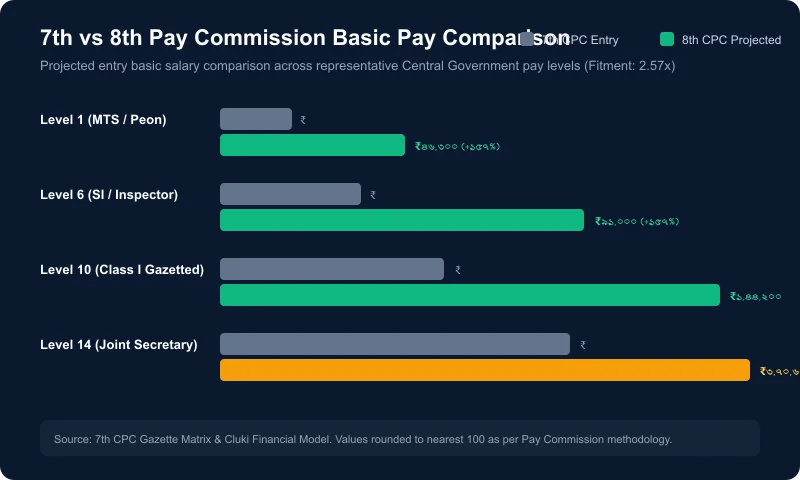
The table below provides a comprehensive comparison of entry-level basic pay across all 18 levels of the 7th CPC Pay Matrix against projected 8th CPC entry figures calculated at your selected fitment factor (2.57x). Use this data alongside our salary calculator to model your department's revised pay scale.
Pay Level
Representative Post / Grade
7th CPC Entry Basic
Projected 8th CPC Basic
Monthly Increase
% Growth
💡
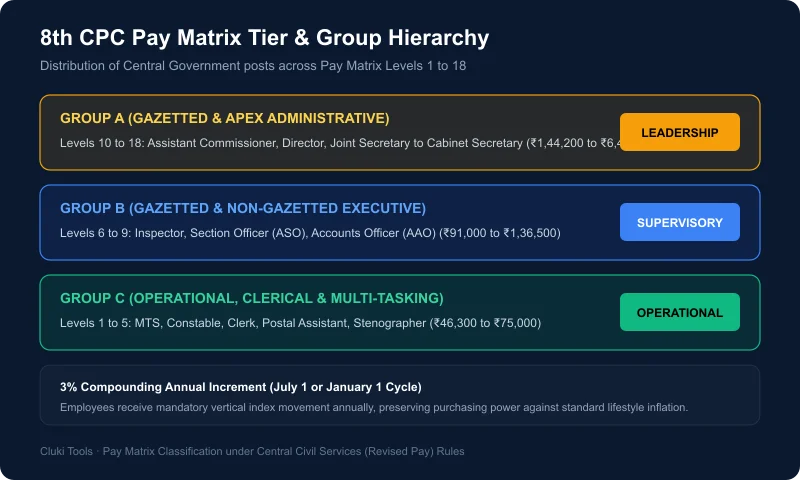
Note on Minimum Wage: Under the 7th Pay Commission, Level 1 minimum pay was set at ₹18,000. At a 2.57x fitment factor in our salary calculator, minimum central government basic pay rises to ₹46,300, whereas a 2.86x factor would raise it to ₹51,500 per month. Central aspirants can check active vacancies and pay structures on our pay matrix guide.
8th CPC Pay Matrix Increment Visualizer
In the Central Pay Commission framework, vertical progression within each pay level occurs through annual increments set at approximately 3% compounding growth across defined index cells. Below is the projected 12-stage annual increment ladder for the selected level under the 8th CPC, illustrating how our 8th CPC salary calculator projects progressive career earnings.
Index Stage
Years of Service (Stage)
7th CPC Pay Matrix
Projected 8th CPC Pay Matrix
Annual Increment (₹)
Pension & Family Pension Revision Under 8th CPC
The Terms of Reference formally approved by the Union Cabinet stipulate that central government pensioners who retired on or before December 31, 2025 are covered under the notional pay parity scheme. Basic pension is computed at 50% of the last drawn basic pay, while ordinary family pension is calculated at 30%.
Pension Category
Formula Ratio
7th CPC Benchmark (Level 1)
Projected 8th CPC (2.57x)
Projected 8th CPC (2.86x)
Minimum Regular Pension
50% of Minimum Basic Pay
₹9,000
₹23,150
₹25,750
Minimum Family Pension
30% of Minimum Basic Pay
₹5,400
₹13,890
₹15,450
Maximum Pension (Level 18)
50% of ₹2,50,000 / Revised
₹1,25,000
₹3,21,250
₹3,57,500
Additional Pension (80+ Years)
+20% of Basic Pension
+₹1,800
+₹4,630
+₹5,150
Additionally, Dearness Relief (DR) is granted to pensioners at the exact same rate as Dearness Allowance (DA) for serving staff, providing inflation neutralization over the 10-year commission cycle.
Comprehensive Guide: Understanding the 8th Central Pay Commission
1. Historical Evolution of Central Pay Commissions
Pay Commissions have served as the institutional backbone of Indian public service compensation since independence. Convened approximately once every ten years, their constitutional mandate is to review the remuneration, retirement benefits, and conditions of service for central government employees and defence forces.
1st CPC (1946): Standardized post-colonial pay scales, establishing a minimum wage of ₹55 per month.
6th CPC (2006): Pioneered the Pay Band and Grade Pay structure, dramatically increasing take-home pay.
7th CPC (2016): Replaced grade pay with the 18-level Pay Matrix and applied a 2.57x fitment factor, establishing an ₹18,000 minimum basic pay.
8th CPC (2026): Established to recalibrate pay after a decade of macroeconomic transition, cumulative inflation, and the implementation of the Unified Pension Scheme (UPS).
On January 16, 2025, the Union Cabinet chaired by the Prime Minister approved the constitution of the 8th Central Pay Commission, announced through the official Press Information Bureau (PIB) Cabinet release. This was formalized through a Gazette Notification on November 3, 2025, appointing Justice Ranjana Prakash Desai (Retd.), former Judge of the Supreme Court of India, as Chairperson.
The Commission operates under the administrative aegis of the Department of Expenditure (DoE), Ministry of Finance, and consults closely with the Department of Personnel and Training (DoPT). It has been given an 18-month timeframe to finalize and submit its comprehensive report. Key milestones include:
January 16, 2025
Cabinet Approval for 8th CPC Formation
Union Cabinet formally greenlights the constitution of the 8th Pay Commission prior to the conclusion of the 7th CPC 10-year term.
October 28, 2025
Terms of Reference (ToR) Approved
Fixes January 1, 2026 as the formal reference date for pay revision and includes pensioners retiring up to December 31, 2025.
November 3, 2025
Gazette Notification & Leadership Appointment
Justice Ranjana Prakash Desai formally appointed as Chairperson, initiating staff-side stakeholder submissions.
Mid 2027 (Expected)
Submission of Final Recommendation Report
Commission submits the revised pay matrix, allowance structure, and pension formulas to the Union Finance Minister.
Late 2027 / 2028
Cabinet Notification & Arrears Disbursal
Cabinet issues the implementing Office Memorandum (OM). Revised salary credit begins with lump-sum arrears backdated to January 1, 2026.
3. The Mechanics of the Fitment Factor & Formula
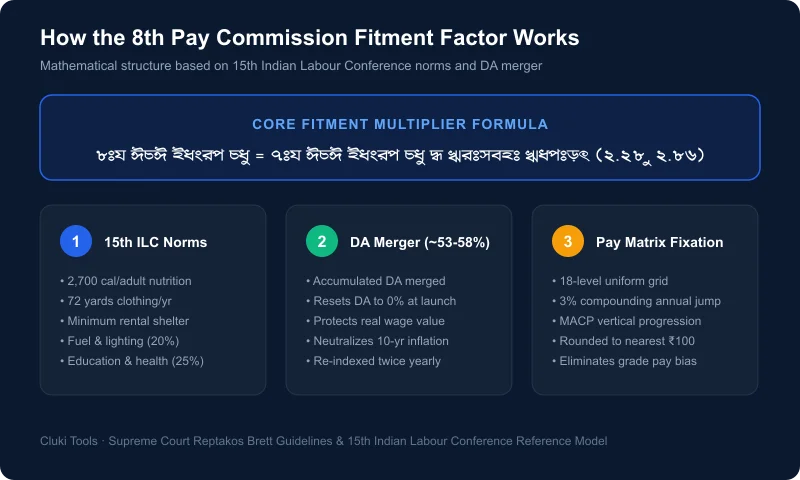
The fitment factor is the foundational multiplier applied across all pay levels in our salary calculator to convert existing 7th CPC basic pay into revised 8th CPC basic pay:
To understand how the Commission arrives at this number, economists analyze the 15th Indian Labour Conference (ILC) norms for minimum family consumption, updated by the Ministry of Labour & Employment (Labour Bureau):
Food Requirement: Net minimum intake of 2,700 calories per adult equivalent (family of 3 consumption units).
Clothing Requirement: Minimum 72 yards of cloth per annum per family.
Housing (HRA): Rent corresponding to minimum subsidized accommodation.
Fuel, Lighting & Miscellaneous: Constituting 20% of the total minimum wage expenditure.
Children Education, Medical & Recreation: 25% added as per the Supreme Court landmark ruling in Reptakos Brett & Co.
Comparing this modern consumption expenditure threshold against the baseline ₹18,000 basic pay establishes the mathematical justification for fitment factors between 2.28x and 2.86x in this salary calculator.
4. Allowances Structure: HRA, DA & Transport Allowance
Beyond basic pay, central government compensation comprises three major variable allowances:
Dearness Allowance (DA): Paid to neutralize the impact of inflation based on the 12-month average of the All India Consumer Price Index for Industrial Workers (AICPI-IW), maintained by the Labour Bureau. When DA crossed 50% in early 2024, allowances like Children Education Allowance (CEA), Hostel Subsidy, and Gratuity limits under the Controller General of Accounts (CGA) rules were raised by 25%. Under the 8th CPC, the entire accumulated DA is merged into the new basic pay, resetting DA to 0%.
House Rent Allowance (HRA): Categorized into Class X (27%), Class Y (18%), and Class Z (9%). Even without altering the percentage figures, an employee in Delhi whose basic pay increases from ₹35,400 to ₹91,000 sees their monthly HRA rise from ₹9,558 to ₹24,570.
Transport Allowance (TPTA): Compensates for daily commuting expenditure. Distributed into Higher TPTA cities (19 major urban agglomerations) and Other Places, and linked with prevailing DA rates.
5. Financial Advisory: How Employees Should Prepare
A substantial pay revision and lump-sum arrears payment present major wealth-building opportunities if managed prudently:
Resist Pre-Committing Arrears to New Debt: Avoid entering high-interest automobile or consumer durable EMIs predicated on anticipated arrears before the official Cabinet notification is issued.
Strategize Tax Regime Optimization: Substantially higher basic pay will alter your optimal choice between the New Tax Regime (Section 115BAC) and the Old Tax Regime. Evaluate deductions under Sections 80C, 80CCD(1B), and 24(b).
Prioritize High-Interest Debt Elimination: Use arrears payouts to accelerate home loan principal prepayments, drastically reducing long-term interest burdens.
Review Pension System Transitions: Analyze your retirement coverage under the Unified Pension Scheme (UPS) vs National Pension System (NPS), taking into account the 50% assured pension guarantee.
How to Calculate Your 8th CPC Salary? (Step-by-Step)
Follow these 5 straightforward steps using our interactive modeling tool to compute your estimated revised monthly pay packet:
Select Your Pay Level: Choose your current 7th CPC Pay Matrix level from the dropdown (Levels 1 to 18). Example: Select "Level 6 (GP 4200)" for Inspectors, Sub-Inspectors, and Section Officers.
Verify Your Current Basic Pay: The entry basic pay loads automatically, or you can enter your exact current monthly basic pay. Example: Enter ₹35,400 for entry Level 6, or your updated incremented basic.
Choose or Adjust the Fitment Factor: Use quick preset buttons (2.28x Budget Floor, 2.57x 7th CPC Baseline, 2.86x JCM Proposal) or drag the slider. Example: Setting 2.57x models basic pay revision directly matching the 7th CPC multiplier.
Select City Classification & Assumed DA: Pick Class X (27% HRA for metro cities), Class Y (18%), or Class Z (9%), and adjust the assumed DA rate if needed. Example: Select Class X for Delhi, Mumbai, Kolkata, Bengaluru, or Chennai postings.
Review Projected Gross & In-Hand Pay: Instantly inspect the real-time breakdown of revised basic, assumed DA, HRA, TA, and statutory NPS/tax deductions. Example: At Level 6 with 2.57x in Class X, projected gross is ~₹76,373 with estimated net in-hand of ~₹66,747.
When will the 8th Pay Commission be implemented and effective?
The Union Cabinet approved the constitution of the 8th Central Pay Commission with a formal reference date of January 1, 2026. The Commission, headed by Chairperson Justice Ranjana Prakash Desai (Retd.), has been allocated an 18-month reporting window to deliver its final recommendations (expected mid-2027). Following Cabinet approval, revised pay credit is expected in late 2027 or 2028, with retroactive arrears disbursed back to January 1, 2026.
What is the expected fitment factor for the 8th CPC?
While the official fitment factor has not yet been notified, active proposals range from a conservative baseline of 2.28x (budget-conscious scenario) to 2.57x (matching the 7th CPC ratio) and an employee federation / JCM demand of 2.86x. Most financial analysts project the final figure will land between 2.28x and 2.86x.
How does the 8th Pay Commission salary calculator compute revised basic pay?
Revised Basic Pay is calculated by multiplying your current 7th CPC Basic Pay by the approved Fitment Factor and rounding to the nearest hundred rupees or defined cell in the new 8th CPC Pay Matrix. Formula: 8th CPC Basic Pay = 7th CPC Basic Pay × Fitment Factor.
What will happen to Dearness Allowance (DA) upon 8th CPC implementation?
Under standard Pay Commission methodology, accumulated Dearness Allowance is merged into the revised basic pay structure via the fitment factor. Once the new pay scales are implemented, DA is reset to 0% and starts accumulating afresh based on the AICPI-IW index.
What are the projected HRA rates for X, Y, and Z class cities under 8th CPC?
Under the existing rules, House Rent Allowance is 27% for Class X (50L+ population metros), 18% for Class Y (5L-50L population cities), and 9% for Class Z (population under 5L). Even maintaining current percentage rates results in a massive nominal rupee increase because HRA is computed on the much higher revised basic pay.
How will central government pensions and family pensions be revised?
Central government pensions are established at 50% of the last drawn basic pay, while family pensions are 30%. Under the 8th CPC Terms of Reference, pensioners retiring on or before December 31, 2025 are covered under notional pay parity, meaning their basic pension will be recomputed using the new fitment factor, accompanied by Dearness Relief (DR).
What is the difference between Gross Salary and In-Hand / Net Salary in this salary calculator?
Gross Salary represents the sum of revised Basic Pay, Dearness Allowance (DA), House Rent Allowance (HRA), and Transport Allowance (TA). Net In-Hand Salary is the amount credited to your bank account after statutory deductions, primarily the mandatory 10% NPS/UPS contribution (Basic + DA), CGHS, CGEGIS, and estimated Income Tax.
Will the 8th CPC retain the 18-level 7th CPC Pay Matrix structure?
Yes, administrative feedback and expert representations overwhelmingly support retaining the transparent 18-level pay matrix structure introduced by the 7th CPC. The matrix eliminates legacy grade-pay ambiguities and standardizes annual increments at a compounding 3% across uniform vertical index stages.
How will Modified Assured Career Progression (MACP) be calculated under 8th CPC?
Under MACP, central government employees who do not receive regular functional promotions are granted financial upgradation at 10, 20, and 30 years of continuous service. Under the 8th CPC, MACP benefits will simply transition an employee vertically to the next higher level's cell in the revised pay matrix.
Are state government and public autonomous body employees covered by the 8th CPC?
The Central Pay Commission recommendations formally apply only to Central Government employees, Defence personnel, Railways, Postal staff, and Union Territory administrations. However, most Indian state governments and autonomous universities historically adopt the Central Pay Commission pay matrix with state-specific modifications within 6 to 24 months of central implementation.
Methodology & Assumptions
This calculator operates on established Central Pay Commission mathematical principles and historical precedents:
Revised Basic Pay Formula:Revised Basic = Current 7th CPC Basic × Fitment Factor (rounded to the nearest ₹100 as per 7th CPC standards).
DA Assumption: Projected baseline index buffer of 28% (actual Dearness Allowance rate will officially apply post-notification and AICPI-IW adjustments). Editable directly in the tool.
HRA Rates: Computed on revised basic pay across Census classifications: Class X (30% / 27%), Class Y (20% / 18%), and Class Z (10% / 9%).
Rounding Rules: Nearest ₹100 for Basic Pay and nearest ₹1 for allowances and statutory deductions.
Official Data Sources: Press Information Bureau (PIB), Department of Expenditure (DoE), and Department of Personnel & Training (DoPT) releases.
Disclaimer & Limitation: This is an independent predictive financial projection tool and does not constitute an official government order or gazetted notification. Track all active opportunities on our Central Govt Jobs hub.